


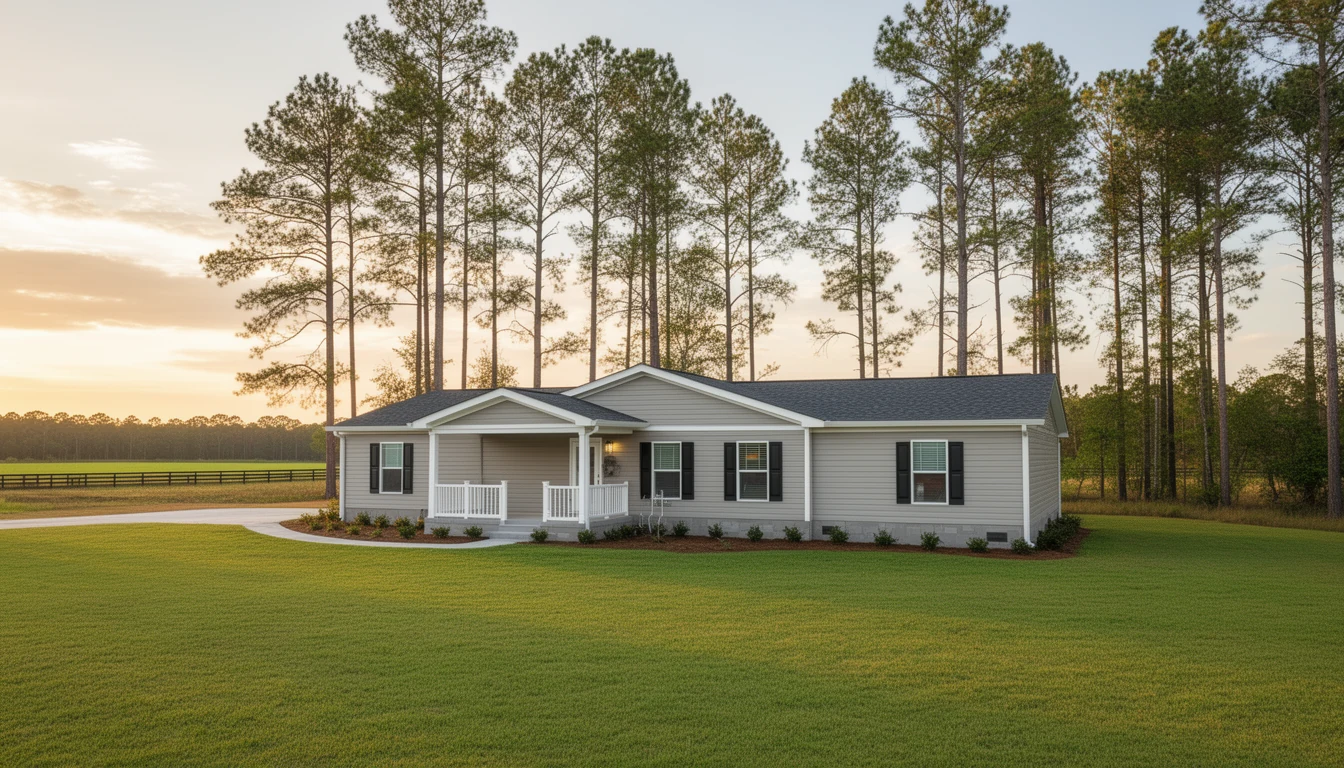
Manufactured homes make up a real share of the rural NC housing market, and Martin County fits that pattern. Statewide, mobile and manufactured homes run about 11.3% of all housing units in North Carolina, roughly twice the national average, and in several of the state’s most rural counties they’re above a third of the occupied stock. Around Williamston, they tend to sit on individually owned lots outside the town limits rather than in the historic in-town neighborhoods, which skew toward older stick-built construction.
For a first-time buyer, that means the search starts with a question most people don’t expect: can this home even be financed the way I’m planning to finance it? Manufactured homes are financed, insured, appraised, and titled differently than stick-built houses, and those differences can decide whether a specific listing is realistic before you ever walk through the front door.
Here’s what lenders actually require, and what you should check before you fall for a listing.
Why do manufactured homes need different financing?
Because they’re built to a different standard and can be titled two different ways. A manufactured home is built in a factory to the federal HUD Code, then transported to its site. That means lenders treat it as a distinct category from stick-built construction, with its own rules about foundations, construction standards, and ownership paperwork.
The two loan programs that matter most in this market, FHA and USDA, both finance manufactured homes. And both start from the same three baseline requirements: the home must sit on a permanent foundation, it must meet HUD’s federal construction and safety standards, and it must be titled as real property rather than personal property.
What is a permanent foundation, exactly?
Not just a description of how the home looks sitting there. It’s a specific engineering standard. The wheels, axles, and towing hitch have to be removed, and the home has to sit on a foundation system engineered to support it permanently in place.
Lenders typically require a licensed engineer’s certification confirming the foundation meets the applicable HUD or agency standard before they’ll treat the home as eligible for real-property financing. That’s not something a buyer or seller can self-certify, so get it in writing early. If the home is still sitting on wheels or blocks without a proper foundation system, that alone can stop the loan.
Why does the 1976 HUD Code cutoff matter?
The federal HUD Code construction and safety standards took effect on June 15, 1976. Both FHA and USDA anchor their eligibility to that date: a manufactured home built before it generally won’t meet either program’s construction-standard requirement, regardless of how well it’s been maintained.
That’s the federal floor. Individual lenders sometimes layer on their own age or condition overlays, so confirm the current lender-specific cutoff before assuming a given unit qualifies. In practice, a pre-1976 unit is usually a cash purchase or a personal-property loan situation, not an FHA or USDA mortgage.
What does it take to title a manufactured home as real property?
In North Carolina, converting a manufactured home from personal property to real property is a two-step process, and it isn’t automatic just because the home looks permanently sited.
First, the owner files an Affidavit for Removal of Manufactured Home from Vehicle Registration Files, DMV Form MVR-46G, with the NC Division of Motor Vehicles, surrendering the original title. Once the DMV signs and returns that affidavit, it has to be recorded with the Register of Deeds in the county where the property sits. That recording step is what actually makes the home real property under North Carolina law, not the DMV filing by itself.
Why does this matter so much? Most residential mortgage financing, including FHA and USDA, is built around real property. A manufactured home still titled as a vehicle generally can’t get a standard mortgage at all. It needs the far less favorable terms of a personal-property, or chattel, loan, if it can be financed conventionally as a home purchase at that stage. Before writing an offer, confirm in writing whether the title has already been retired and recorded, or whether that step still needs to happen. If it hasn’t happened yet, build the time and paperwork for it into your contract, because it isn’t quick.
What will disqualify a manufactured home from a standard mortgage?
Any one of these is enough for a lender to decline the loan outright rather than flag it for repair:
- No permanent foundation, meaning still on wheels or blocks without a proper foundation system
- A build date before June 15, 1976
- Still titled as personal property rather than real property
- Sited on leased land rather than land you own
- Additions or modifications made without proper permitting that put the home out of compliance with HUD standards
That’s why confirming these items belongs at the start of your search on a specific listing, not after you’ve already fallen for the place.
What should you inspect before you write an offer?
A general home inspector isn’t necessarily trained to evaluate manufactured-home systems the way they are stick-built construction. Ask upfront whether the inspector you’re hiring has manufactured-home experience, and consider a specialist if not. Pay specific attention to:
- Foundation and tie-downs. Confirm the foundation matches what was actually engineered and certified for the home, not just that it looks solid. Check that anchor and tie-down straps are present, properly tensioned, and free of rust-through, especially in a storm-exposed region like this one.
- Skirting. It’s not cosmetic. It protects the belly wrap and undercarriage from moisture and pests, and gaps or damage invite both.
- Roof and siding. Manufactured-home materials are frequently lighter gauge than stick-built construction and show wear differently. Look for seam separation on the roof and panel damage or moisture staining on the siding.
- Moisture and the belly wrap. Water intrusion into the underside is harder to spot than a wet stick-built crawlspace and can cause serious hidden damage before it’s visible from inside. This is one of the best reasons to get a manufactured-home-experienced inspector underneath the unit.
- HVAC and utility hookups. Confirm how the home is set up for water, sewer or septic, and electrical. Older or previously relocated units sometimes have configurations that don’t meet current code.
What does this mean for a Martin County buyer?
The honest trade-off: manufactured housing is one of the most realistic paths to homeownership in this market, and it carries paperwork and inspection burdens that stick-built buyers never think about. The good news is that the county’s pricing and rural eligibility line up with the loan programs that work best here. USDA financing, which dominates first-home purchases in this market, requires no down payment, and FHA works when USDA doesn’t fit, with 3.5% down at a 580 or higher credit score. A well-sited, properly titled manufactured home on its own lot can be a genuinely affordable way in.
The catch is that every one of those advantages depends on the details: the foundation certification, the title status, the build date, the condition of the undercarriage. A manufactured home that checks those boxes is a different buying experience than one that doesn’t, and the difference shows up at the lender’s desk, not at the showing. Sort out the foundation and the title before you get attached, and you’ll know exactly what you’re walking into.
Information deemed reliable but not guaranteed. Verify program rules, lender-specific requirements, and current market conditions with your lender, a qualified local professional, and the agencies listed above before making any purchase decision.