

Buying timberland isn’t like buying a house, and it isn’t quite like buying farmland either. On a timber tract, two different values sit on the same acreage: what the ground is worth bare, and what the trees standing on it are worth. For many tracts in Martin County, the trees are the bigger number. Understanding how that number gets set is the difference between paying for timber you’re actually getting and paying for timber that was cut five years ago.
Here’s what you need to know about timber cruises, stumpage rates, and valuing standing timber before you make an offer.
What is a timber cruise?
A timber cruise is a professional inventory of the trees on a property: species, size class, volume, and quality. A forester walks the tract, measures sample plots, and estimates how much merchantable timber is standing there in board feet or tons.
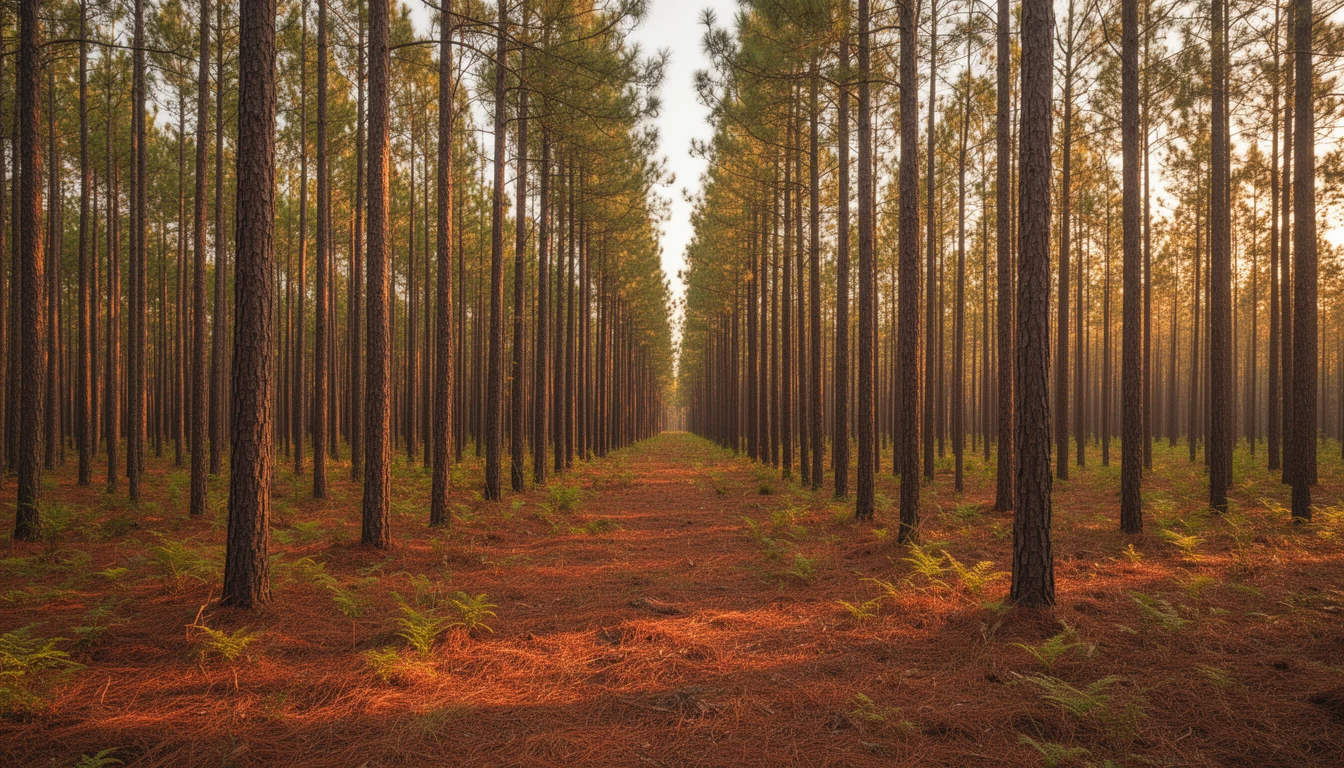
Ask for a recent cruise instead of relying on a seller’s estimate or your own walk-through impression. Two tracts that look identical from the road can carry very different timber value depending on how they’ve been managed. Adjacent stands of loblolly pine can differ by decades of growth, thinning history, and storm damage.
How do stumpage rates actually work?
Stumpage is the price a mill or logger pays for standing timber, quoted per unit: per ton for pulpwood, per thousand board feet for sawtimber. It’s not a sticker price you negotiate. It’s set by regional markets, current demand at the mills, and the size and quality of the timber itself.
Regional pine sawtimber and pulpwood prices move meaningfully by season, and they’re only current as of the date they’re published. Don’t rely on a figure you read in any blog post, including this one. Check the NC State Extension Forestry quarterly price report, or hire a licensed forester for a current valuation.
Why do timber value and land value get separated?
Standing timber and bare land are two different assets that happen to sit on the same tract. Bare land value reflects location, access, soil, and drainage: what the ground is worth regardless of what’s growing on it. Timber value reflects the merchantable volume standing on it at current stumpage rates.
The split matters for two reasons. First, a list price can be justified by timber that may already be spoken for. Second, timber rights can be sold separately from the land. If a cutting contract is still in effect from a prior sale, you could buy the land without buying the trees on it.
What should you ask before you make an offer?
- Is there a recent timber cruise, and can I see it?
- Is there a written forest management plan? It’s required if the land is enrolled in present-use value under the forestry category, and it documents species, stocking, age class, and planned harvest schedule.
- Have timber rights ever been sold separately from the land?
- Is there a cutting contract still in effect?
- What’s the harvest history? When was the last cut, and what came off the property?
How does timberland change your due diligence?
Boundary marking on a 1,000-plus-acre tract is a different undertaking than on a residential lot. Lines are sometimes marked only by old blazed trees, faded paint marks, or fence remnants deep in the woods. A full boundary survey on acreage this size takes longer and costs more than buyers coming from residential purchases expect. Budget for both the time and the money.
Beyond the boundary, check for utility and pipeline easements crossing the tract and recorded access easements. Large rural tracts are sometimes reachable only via an easement across a neighbor’s land. Confirm it rather than assume it.
Wetlands deserve particular attention on river-adjacent timberland here. The Roanoke River’s bottomland forest is one of the largest intact, least-disturbed floodplain forest ecosystems remaining in the mid-Atlantic. Federal wetlands regulation under Clean Water Act Section 404 and FEMA floodplain rules carry real weight on what you can clear, drain, or build without a permit. If your plans include converting acreage, building new structures, or any significant land-disturbing work, get a wetland delineation and check FEMA flood maps before you close.
Why does Martin County produce large tracts at all?
The bottomland along the Roanoke was held in large industrial timber ownership for decades, and that history still shapes the market. In 1989, The Nature Conservancy bought roughly 10,600 acres from Georgia-Pacific across Bertie and Martin counties, land that helped establish the Roanoke River National Wildlife Refuge and the adjoining state-owned Roanoke River wetlands. That’s the scale these old industrial holdings ran at, and it’s part of why large contiguous tracts still surface here more often than in more subdivided parts of the state.
Tracts on the order of Cherry Island (roughly 1,342 acres) and Devil’s Gut (roughly 1,394 acres) exist in the region as examples of the scale this market can produce, not as active listings.
What does timberland cost to carry?
The honest trade-off: timberland rewards patience and punishes shortcuts. The upside is real. A well-managed loblolly pine stand on a 25-to-30-year rotation carries meaningful value in the trees themselves, and Martin County’s per-acre pricing generally runs lower than comparable acreage closer to growth corridors. The other side is that the value is locked in a slow-growing asset. You’re not buying a quick return; you’re buying timber that’s decades in the making, plus the taxes, the diligence work, and the carrying costs while it grows.
If you want the land to produce income in the meantime, a hunting lease is an option. Lease rates in parts of the Southeast have reportedly moved up in recent years toward something closer to $10 to $18 per acre, but that’s volatile and site-specific. Confirm current local rates with a land manager or broker who tracks this market before you use any figure to value a property. If an existing lease comes with the tract, get its term, renewal date, and whether it terminates at closing or transfers to you. Address it in the contract either way.
The bottom line
Martin County’s timberland equation is straightforward: large, affordable acreage with a real timber story, available to buyers who understand the trees are part of the deal, not a bonus. Get the cruise, check the stumpage market, sort out the boundary and the wetlands, and you’ll know exactly what you’re paying for. Skip those steps, and you might pay for trees that were sold out from under you years ago.
Information deemed reliable but not guaranteed. Verify all details, particularly stumpage rates, hunting lease figures, and USDA program status, with a qualified professional and current market data before making any purchase decision.