

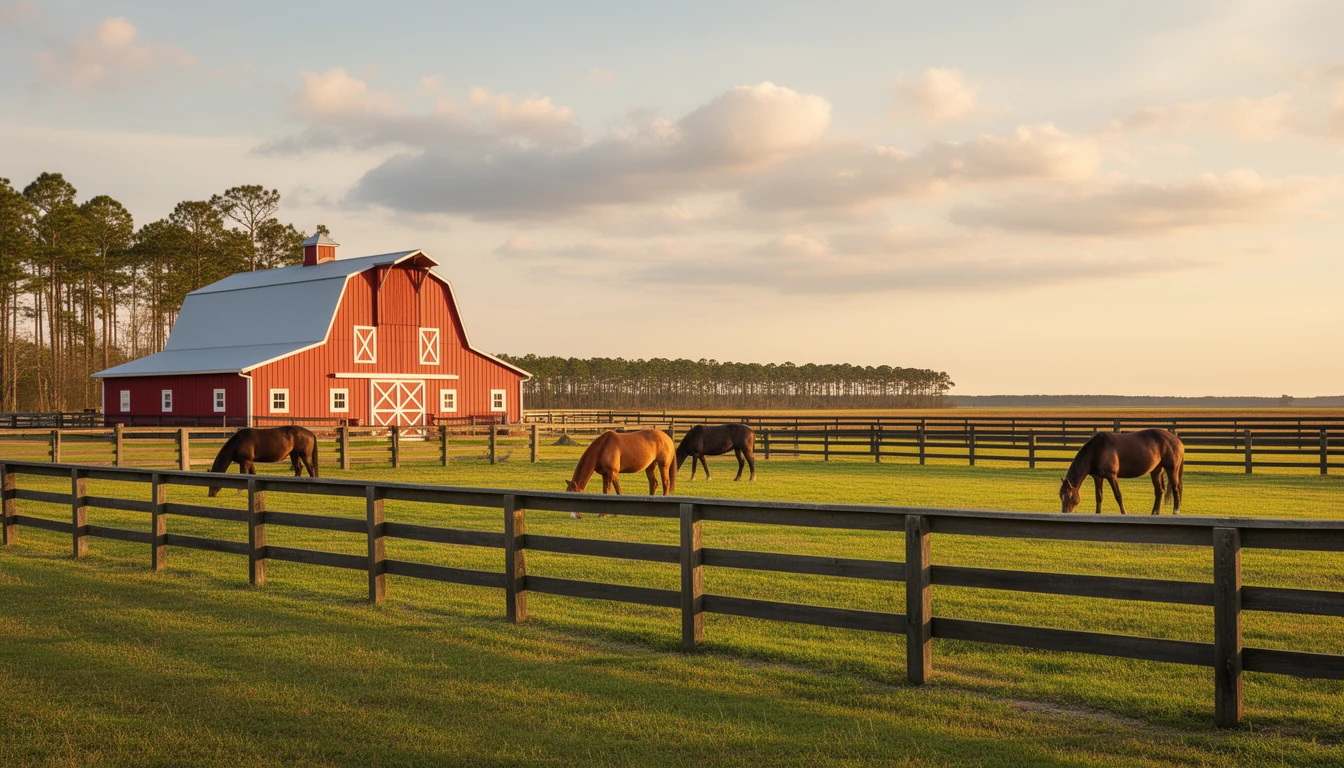
The Senator Bob Martin Eastern Agricultural Center and Martin Community College’s equine program do a lot of the work explaining why equestrian buyers look at Martin County at all. Together they give the county something most rural places this size don’t have: a regional show venue and a trained labor pipeline in the same small market.
If you’re shopping for horse property in eastern North Carolina, here’s what those two anchors actually mean for your search.
What is the Senator Bob Martin Eastern Agricultural Center?
The Center sits at 2900 NC Hwy 125 South in Williamston, just off US-64 at Exit 512, and it’s been running events since 1998. It’s owned and operated through the NC Department of Agriculture & Consumer Services’ Marketing Division, which is why it functions more like public agricultural infrastructure than a private events hall.
In a recent year the Center booked the coliseum arena roughly 41 weeks and logged around 80 meeting-center bookings on top of that. The calendar includes NCHJA-sanctioned “C”-rated hunter/jumper shows, miniature horse shows, the county’s 4-H youth livestock show, rodeos, truck and tractor pulls, farm heritage fairs, concerts, even motocross and boat shows. The horse shows alone run close to monthly. You can check what’s actually booked on the Center’s event calendar at ncagr.gov before you plan a visit around it.
Why does the show calendar matter to buyers?
This isn’t a facility that draws a handful of local riders on weekends. NCHJA-sanctioned shows and breed-specific events pull competitors and their trailers in from well outside Martin County. Exhibitors travel to Williamston the way they’d travel to any regional show-circuit stop, which is a different draw than a typical county fairground produces.
For a property buyer, the practical effect is a recurring schedule of horse-people traffic through the county. That supports boarding demand and short-term lodging around show weekends, and it keeps the local equestrian economy moving even in the off-season.
What makes Martin Community College’s equine program unusual?
Martin Community College is the only community college in North Carolina offering both an Equine Business associate degree and a separate Equine Training credential. Most NC community colleges don’t touch equine programming at all, so this is a genuine one-of-a-kind asset for the county.
The campus sits one mile west of Williamston at 1161 Kehukee Park Road, with a 600-seat equine arena, two horse barns, an outdoor riding ring, dedicated equine classrooms, and a herd of 40-plus horses used for instruction. Coursework covers farm and stable management, breeding, nutrition, judging and selection, and equine health. Students get assigned their own horse and manage it day-to-day for the length of the program. Credentials run from a two-semester certificate up through a two-year A.A.S. degree.
Practically, that means a steady pipeline of people trained for equine-property work: barn managers, trainers, breeding-operation staff, riding instructors. That’s not something most rural counties this size can offer a buyer setting up a working horse operation.
What does this mean for property values?
Proximity to the Ag Center and MCC’s equine program is a real factor in how equestrian buyers evaluate a property, though there’s no clean, defensible premium figure to put on it. No specific percentage or dollar amount holds up across different properties. What’s more reliable is directional: all else equal, a horse property within easy trailering distance of the Ag Center’s show schedule and MCC’s program tends to draw more serious equestrian-buyer interest than an equivalent property with no connection to either.
Who’s actually buying equestrian property in Williamston?
The buyer type these two anchors pull in tends to be specific: people relocating into the county for the equestrian infrastructure itself, not people who happen to want a horse property wherever they land. That includes out-of-state buyers building a training or boarding operation who’ve done the math on this being one of the few places in the region with both a college pipeline and a show venue, and riders who want to be near an active horse community rather than isolated on acreage with no local scene.
That’s usually a buyer who already knows the Ag Center’s calendar and MCC’s program before a showing even starts. It’s typically already why they’re looking here instead of somewhere else in the region.
Is the equestrian angle right for every buyer?
No, and it’s worth being honest about that. The Ag Center and the college program matter most if you’re planning to board, train, show, or hire equine labor locally. If you’re buying land in Martin County for other reasons, those two anchors are background context, not a reason to pay more for a parcel you don’t need near a show venue.
The trade-off cuts the other way too: the same rural setting that makes room for a working horse operation means you’ll drive for most amenities, and the county’s thin market means property comparisons are limited. The buyers who do well here are the ones who come in with a specific use in mind and verify the details, from the show calendar to the barn’s electrical system, before they write an offer.
Information deemed reliable but not guaranteed. Verify event calendars, program offerings, and current market conditions with the Center, Martin Community College, and a qualified local professional before making any purchase decision.